Thứ Sáu, 14 tháng 3, 2014

During their stay in Hanoi, most tourists insist on a trip to Van Phuc Silk Village, the famous silk village of Hanoi to contemplate the genuine traditional silk-making industry.

Van Phuc Silk Village is situated on the banks of Nhue Thi River, Nguyen Trai Road, near Ha Dong city, 8 km southwest of Ha Noi. It takes you only 30 minutes by motorbike to go there from the centre of Hanoi. The village has been much well known for its traditional sericulture, weaving, and silk products. Tourists coming here are lured by various beautiful shirts, crafts, ties, dresses and many other things made of silk available in the village. What is special is that the silk is made by very simple looms, which is the genuinely traditional Vietnamese way of making silk.

For centuries, silk has always been considered an extreme luxury, on par with rhinoceros horn, ivory and precious handworks in Vietnam. It has long been a universal byword of luxury, often worn by the richest, most powerful citizens. Most visitors somehow have heard about the significant role of this kind of material in Vietnam, yet might wonder where the cradle of Viet silk is. The mentioned Van Phuc Silk Village is proud to be the origin of best silk and silk-making industry of Vietnam, which is attached to a long-lasting history of more than two thousand years. Though passing by lots of ups and downs, during the recent years, the village’s craft has enjoyed revival due to a surging demand for silk in both the domestic and foreign markets.

Today, the fine and lustrous cloth that originates from the cocoon of the silkworm is more affordable for "ordinary" folk. Furthermore, silk is currently enjoying a fashion renaissance, particularly since its many varieties can be made into a wide range of designs suitable for all facets of modern life. Should you intend to have a silk pair of formal clothes made, just come here and select your suitable materials, and professional tailors here will bring you satisfaction!
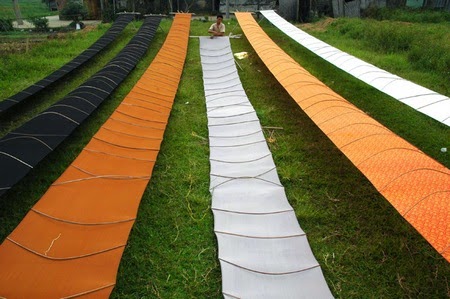
Like other visitors to the village, you will be surprised at this “silk shop town”, where almost all houses along the paths have been turned into shops selling silk products. Specifically, the village is now home to 1,280 households, 90% of whom are involved in silk production and business. The village makes more than 2 million meters of silk per year. Yet, more than that, you are offered a good chance to explore the Vietnamese traditional industry of silk-making.

No tourists here are uncontented with the glisten of various silk products. They are always confronted with an initially bewildering array of silk products, from raw materials, to garments, and a myriad of silk accessories. The local silk is known for its smooth and lightweight appearance, and qualities that enable it to be dyed more colors to suit a variety of skin tones. In order to cater for the changing demands and tastes of customers, Van Phuc silk producers are expanding their silk and garment repertoire: traditional glossy, embroidered silks, double layers, wrinkled silks, and of course, more colours, hues and weights, for which they have invented new techniques in dying and thermo-processing the threads.

If you are going to buy something from Vietnam as gifts for those at home, silk and clothes made of silk are available around in the village for your choice. Though the days when Vietnam's silk was reserved for nobility are long gone, what would never change is the sense of romance and luxury imparted by silk, a luminous cloth type. With 2000 years of history behind them, the silk weavers of Van Phuc Silk village are still busy, weaving dreams.

How to get there? With a view to reaching Van Phuc village, tourists should travel south west out of Ha Noi on Nguyen Trai Street until they reach the border of Ha Dong District. Then turn right and dive for about 3km. The village is on the left, some 8 km from central Hanoi. Motorbike, bus, or taxis are all of good use.

Or, tourists can book a day tours visiting handicraft villages around Hanoi to visit this village. Almost every handcraft or culture tours in Hanoi include Van Phuc silk village. As these tours offered are usually just one day tour from Hanoi, it is easy for tourists to arrange their time. 
Ngũ Xã village is located on the side of Trúc Bạch Lake in Ba Đình District nowadays, and it is known as the craft village with traditional bronze casting profession.

Legend has it that Zen Buddhist Grand Monk named Không Lộ who lived in the Lý Dynasty (1009-1225) was progenitor of the profession. He took best workers of five villages from the original Kinh Bắc area (Bắc Ninh Province today) to Thăng Long to establish a copper casting village called Ngũ Tràng Xã.
Since the 17th century, Ngũ Xã Village has become famous with many domestic appliances such as boilers, trays, and basins. Other famous products made by Ngũ Xã Village include Buddha statues, bells, incense burners, among which the greatest work is the bronze statue of Trấn Vũ God in the Quán Thánh Temple in Hà Nội.

The statue is 3.96 meters high, four tons in weight and was completed in 1677. In the temple of the village, there exists a Buddha statue with 5.5 meters high, weighting 14 tons, completed in 1952. In the 19th century, there were 90% of households in the village which ran the same copper casting job with some sophisticated technologies and know-how handed down from generation to generation.

Through many ups and downs of history, Ngũ Xã Village still preserves the traditional profession. Many high quality fine art products of Ngũ Xã have been exported, and many art works by famous artists have been made in the village.
Bát Tràng, a small village in the north of Việt Nam, is about 13 kilometers southeast of Hà Nội center, on the other side of the Red River. The village is famous for ceramic and pottery products of high quality.

If you have known about Việt Nam, you may not be surprised that Bát Tràng’s vases, bowls, dishes, and many other kinds of ceramic products have been exported worldwide.
Bát Tràng Village is said to be established in the 14th or 15th century in several documents.

However, according to the villagers, the village perhaps appeared earlier. There are always two stories concerning the village’s origin. One of these tells that under Lý Dynasty, in 1100, when the nation was in its independence and initial growth period, there were three scholars who came back from their mission trip to China bringing the ceramic craft industry learned there back to Việt Nam and taught the people of Bát Tràng.

In the other story, the village history dates back to the 10th century, when King Lý Công Uẩn relocated the capital in Thăng Long. With the establishment and development of the capital, many businessmen, crafters from many areas come to settle down here to work and trade. In Bát Tràng, there was a lot of white clay, so that many potters…

Accordingly, Bát Tràng has gradually changed from a normal ceramic and pottery village into a famous ceramic and pottery center until now.

As time went by, the village’s products have become well known for their best quality, style and glaze, both inside and outside of the nation. Many of these are now customized for aristocratic families and religious needs. Their popular foreign markets are Japan, the Netherlands, the UK, Portugal, and Southeast Asia, etc.

To produce a complete product, one must follow three steps. The first step is making the product body. The artists select the suitable clay, treat it and start making a raw product. It must be repaired to get the best appearance. Secondly, they decorate and cover it with glazes. Last but not least, the raw products are baked in three days and three nights. There are several kinds of kilns, yet the temperature must be at 12000 or 13000. After baking, products are brought out, classified and repaired in case there are mistakes. And now we have perfect products.

Bát Tràng products are divided into three kinds based on the purposes of use such as utilitarian wares, cult wares and decorative objects.
Thanks to a long–lasting history and development, the village’s works have been accumulated with a lot of different special designs. One more thing that makes them distinguished is the glaze, which is of high quality and a variety of colors, such as blue, brown, white, moss green, in both breaking and melting glazes.

In fact, there have appeared a number of competitors both domestically and internationally who take advantages of high technology.

Yet most customers prefer the craft products that contain historical and traditional values. Hence, it is no surprise at all that Bát Tràng is still found in busy days and works. More importantly, the village is now so popular that it absorbs a huge annual number of tourists to visit and buy ceramic goods.
Located in Thanh Oai District, Ha Noi city, Chuông Conical Hat Village is well-known for its special product “nón” by many foreign and domestic visitors. This small village is crowded with people who not o­nly come here to place orders but also witness the process of making “nón”.

The main material for making “nón” is palm leaf. Chuông villagers have to choose the white shoots from Phú Thọ Province or “nón” leaf from Hà Tĩnh Province. Bamboo hammocks and conical hats must be imported from other provinces.
Not o­nly old people but also children in this village know how to make conical hats. They take advantage of leisure after harvest time to make “nón”. This occupation helps villagers increase their incomes, improve their living standards and contribute to bettering their home village.

“Nón quai thao”(a kind of conical hat with fringe hanging at both sides) has a unique beauty with pink fringes, 2 yellow and red silk tassels, which is suitable for girls in Spring festivals, village festivities, “chèo” and “quan họ” folk music festivals.

Many Chuông villagers are good at making “nón quai thao”, which is a special cultural feature of the Northern delta in Việt Nam. The conical makers must be meticulous, skillful and have experience as the process is complicated, including choosing, arranging palm leaves, then sticking them o­n the conical ring, and sewing colorful thread. It sometimes takes the artisan a whole day to complete a nice “quai thao” conical hat.

Not o­nly is “quai thao” conical hat ordered by artistic troupes but it is also foreign tourists’ favorite souvenir. Many visitors from Germany, France, England can’t help buying this unique souvenir when they arrive at Chuông Village.
Although the village of Tây Tự was one of the last to switch from traditional farming to cultivating flowers, following the lead of villages like Ngọc Hà and Quảng Bá, it has blossomed into being considered the flower granary of Hà Nội.

Tây Tựu has become famous for its large variety of beautiful flowers that not o­nly grace local markets but are also exported abroad, and all the households in the village have become involved in this industry.
Farmers in Tây Tựu used to specialize in traditional agriculture but this yielded a low income. In the 1990s, however, the farmers changed to growing flowering plants and spices.

These crops brought in good profits and the standard of living in the village improved markedly. The Tây Tựu villagers first planted daisies imported from Taiwan and Singapore, but now are concentrating on growing roses on a large scale. Roses currently account for 70 to 80% of all the flowers cultivated in the region.

The first stage in establishing a flower farm is to prepare the fields by marking furrows with a milling machine and growing seedlings. The second stage - the most important and difficult, as it determines whether a tree will survive or not - is grafting nodes onto the young trees after two months' growth. The grafted plants require special care for the next 20 days, after which the grafts' nylon coverings are removed to allow the grafted shoots to grow.

It takes another three months before the flowers can be harvested, during which time a lot of work such as weeding and spraying insecticide has to be done in the fields.
Son Dong Village in Hoa Duc District, Ha Noi is known as the largest place for sculpturing statues of Buddha in Viet Nam. It is also famous for the traditional craft of carving red-lacquered statues in the ancient style.

For over 300 years, the craft has been preserved and developed by devoted and talented artisans. One of them was Nguyen Duc Dau (1898-1988). In 1986 when the national economy started the renewal process, Dau coordinated with Ha Noi College of Fine Arts to organize training courses in sculpturing statues for people in his commune. Since then, the craft has developed and the village now has 300 households engaging in the craft and about 4,000 skillful sculptors.

The main products of the village are statues of Buddha, saints, national heroes and sacred animals for worshipping, such as horses and cranes. Here, the artisans only use the core of jackfruit trees to create statues because this type of wood is quite durable and rarely cracks which is suitable for making worshipping objects. During sculpturing, each artisan has his own secret to make unique products. Particularly, the artisans in Son Dong have become famous for the technique of sculpturing the faces on the statues. Thanks to the artisans’ skillful hands, the statues look refined with details of soulful and merciful expressions.

In Son Dong, the technique on red-lacquer trimmed with good is rather sophisticated which uses gold and silver litmus. To further develop the traditional craft, the villagers have invested in modern machines and advanced technology, and specialized production. Each workshop takes responsibility for one stage, such as sculpturing, painting and designing.

Thanks to their unique beauty, the products of Son Dong Village are seen in most of the pagodas and temples in Ha Noi and the North. There are also exported to the US and the UK to meet the demand of overseas Vietnamese.
Usually served as a snack with raw garlic, Nem chua is eaten all year round as an appetizer or a side. It is eaten especially for the Lunar New Year by many Vietnamese families.

Nem chua is a meat roll with a sweet, sour, salty and spicy taste which makes the mouth salivate with each bite. Nem chua possesses the local character of each region of Vietnam, due to the differing ingredients and sauces used. Most versions of Nem chua can be distinguished by their name, which is usually named after the area it originated from, such as nem Thanh Hoa, nem Dong Ba in the ancient royal capital of Hue, and nem Ninh Hoa in Khanh Hoa Province, nem Yen Mac in Ninh Binh Province, etc.

Traditionally, to make Nem chua, the main ingredient is pork thigh. Nem chua is made from minced pork, sliced pigskin and a mixture of seasoning and garlic. These contents are mixed thoroughly before being wrapped with aromatic, fresh leaves (usually in banana leaves) into small, boxy rolls before being stored for natural fermentation process for three to five days in a cool place before eating.

In the Lai Vung District of the Mekong Delta province of Dong Thap, the locals take pride in their Nem chua recipe, which has been passed down through many generations. Called “nem Lai Vung” after the district, it became more widely known in 1975 when a local woman, Tu Man, made Nem chua for visitors. She used pork, but she also used pig liver, and then ground them into a mixture with rice, shrimp meat and seasonings. The characteristics of nem Lai Vung and other specialty foods from Lai Vung District are so distinctive and recognizable that they have been registered under a domestic brand name. Tourists to Dong Thap Province can take part in nem Lai Vung cooking classes to learn more about this regional specialty.

The northern areas also create their own favorite varieties of Nem chua. The famous one is Nem Yen Mac, which has been made for a long time in Ninh Binh Province. The number of locals in Yen Mac who can make this kind of Nem chua is small because the work requires not only secret formula but also passion for the work. Nem Yen Mac is eaten with guava leaves, fig leaves and aroma vegetables dotted into nuoc mam (fish sauce) which is mixed with mingled with garlic, lemon juice, pepper and chilli.

While many people prefer the more traditional method of preparation for Nem chua, others enjoy a grilled and unfermented variety of Nem chua. Both traditional and grilled Nem chua are usually served with uncooked sliced garlic and nuoc mam (fish sauce). Whereas nuoc mam adds saltiness and spiciness, some prefer to use chili sauce instead.

Nem chua is best known to the expatriate community and international tourists who have taken an interest in Vietnamese cuisine in recent years...